
How to light a Christmas village
Most lighted village buildings have a round hole in the back or bottom for a small light. You light them with a light cord and bulb pushed into that hole, a battery light kit, or (soon) a cordless rechargeable light. Then you hide the cords and put everything on one switch or timer.
What kind of light goes inside a village building?
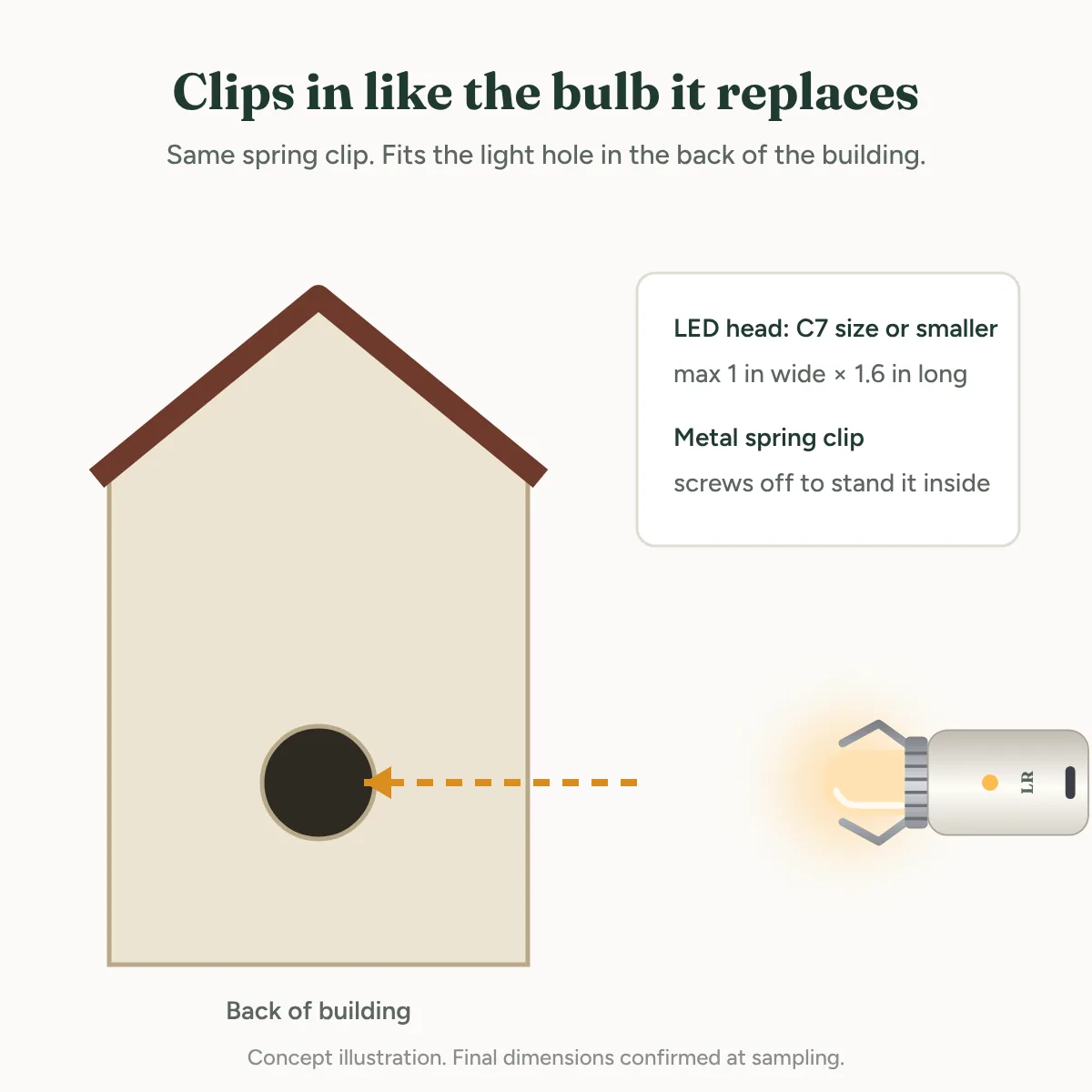
Most ceramic and resin lighted buildings, including many Department 56 pieces, take a small bulb on a light cord. In most of them the bulb is C7 size (about 1 inch wide and 1.6 inches long) on an E12 candelabra socket, and a metal spring clip on the socket holds it in the hole.
Some brands build the light in instead. Many Lemax lighted pieces, for example, run at 4.5 volts, on three AA batteries or a Lemax plug-in adaptor sold separately. Their plugs aren't the same as Department 56 cords, so mixing brands on one power system can take an adapter. Check the bottom of each piece: a round hole with no wires means it needs a cord and bulb; a battery door or a short cord with a plug means it has its own power.
What are my options for lighting each building?
- Corded light sets (wall power). The standard choice: a single cord per building, or a multi-socket cord that lights several buildings from one plug. Inexpensive, though cheap sets do wear out; the work is hiding the cords.
- Battery light cords. A short cord with a bulb runs to a small battery box. No outlet needed, but you still have a cord and you replace batteries.
- USB-powered cords. Low-voltage cords that run from a USB charger or power bank. Handy on shelves far from an outlet.
- Cordless rechargeable lights. A light that clips into the hole with its own battery, controlled by a remote. This is what we're building at Lantern Row; it isn't for sale yet.
Which bulbs should I use?
Match the bulb to the cord. Village cords are either 120-volt (they plug straight into the wall) or low-voltage (3, 4.5, or 12 volts, powered by batteries or an adapter block), and the bulbs aren't interchangeable. A 120-volt bulb in a low-voltage cord stays dark; a low-voltage bulb on 120 volts burns out.
Can't tell what you have? If the cord plugs directly into the wall with no adapter block, it's 120-volt. If there's an adapter or battery box, its label shows the output voltage. If the label is gone, buy a new cord and matching bulb together rather than guessing.
LED replacement bulbs run much cooler than incandescent ones and use less power, which matters inside closed ceramic and resin pieces. For the classic look, choose warm white (around 2700K). Cool white looks bluish next to older pieces. Some LED bulbs flicker on dimmers, timers, or older low-voltage adapters, so test one before buying a dozen.
How do I hide the cords?
- Build the display on a riser or a sheet of foam board and cut holes so cords drop straight down out of sight.
- Run cords toward the back and gather them with cord clips or twist ties behind a backdrop.
- Use multi-socket cords. The sockets are spaced apart (Department 56's are roughly 16 inches) so one cord serves a row of buildings.
- Cover what's left with flame-retardant snow batting, kept off any hot bulbs and loose enough that you can still check the cords.
- Battery kits shorten the cords; cordless lights remove them entirely.
How do I turn the whole village on and off at once?
Plug every cord into one power strip with a switch, then put that strip somewhere you can reach without moving the display. Village bulbs use only a few watts each, so the real limits are the ratings printed on your multi-socket cords and the power strip; add up the bulbs and stay under them. A plug-in timer or a smart plug turns the village on at dusk and off at bedtime automatically. Battery pieces each need their own switch unless they have a built-in timer or a remote.
Is it safe to leave village lights on?
- Use cords listed by a safety lab (look for UL or ETL on the cord or its tag) and replace any cord with cracked insulation, a loose socket, or a stiff, brittle feel. Very old cords are worth replacing outright.
- Don't put a higher-wattage bulb in a cord or building than it's made for.
- Keep incandescent bulbs from touching paper, fabric, or snow batting.
- Don't overload power strips, and use a timer so lights aren't on overnight unattended.
Quick answers
How do I tell what voltage my old village cord is?
If it plugs straight into the wall, it's 120-volt. If it runs from an adapter block or battery box, that label shows the voltage (often 3, 4.5, or 12 volts). If you can't tell, replace the cord and bulb together.
Why does my LED village bulb flicker?
Some LED bulbs don't work well on dimmers, timers, or older low-voltage adapters. Try a different LED bulb or the cord's original bulb type.
How many village buildings can I plug into one power strip?
Village bulbs draw only a few watts each, so the limit is usually the rating printed on your multi-socket cord and power strip. Add up the bulbs and stay under the lowest rating.
What if my building has no light hole?
It probably has a built-in light: look for a battery door, a switch, or a short cord with a plug. Some pieces light only from below through an open base.